Gus answers from your pages, your decisions and your connected tools. Not from a general model’s guess at how your company works.
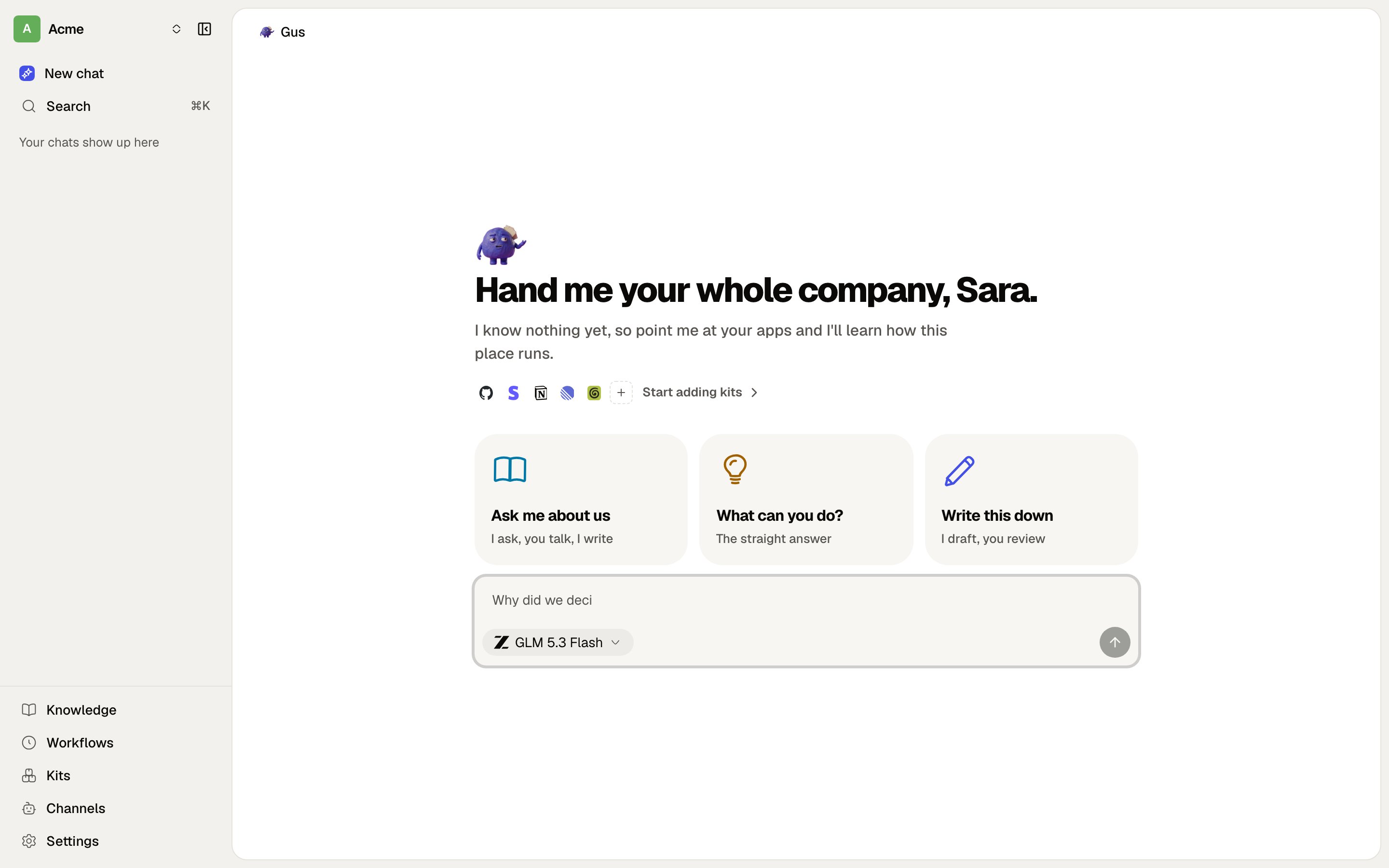
The Gus screen in the Craftspace app

A new install. Gus is honest that he knows nothing yet.

Where it runs

The web app, Slack, Discord and Telegram. A direct message runs as you, with your permissions. A channel runs as its own identity, with an explicit list of page subtrees it can see, so a support channel does not quietly read the whole brain.

What it needs

Two things, both in server settings:
  • An OpenRouter key. One key that every team on the install runs on.
  • A Vercel Sandbox. Gus runs a coding harness in a sandbox, which is where it reads repositories, runs tools and produces work. There is no in-process fallback.

A turn

A turn survives the process that started it, so a long job is not lost to a deploy or a restart. What you see while it runs is its plan, not its current tool call, because a list of tool names is not progress. Gus is a doer rather than a reader. When it finishes a piece of work it captures one durable learning back into the brain, which is what stops a wiki from decaying into whatever somebody wrote in month one.

Errands

When Gus needs a human, it opens an errand: one ask, one person, with a deadline. Not a silent block. It tags the person in the thread rather than sending a DM, and one errand is out per person at a time. Every errand ends. The deadline is the only dial.