> ## Documentation Index
> Fetch the complete documentation index at: https://craftspace.mintlify.site/llms.txt
> Use this file to discover all available pages before exploring further.
# Craftspace
> A company context hub your agents can read.
Craftspace is one place for the context a team keeps in its head: how the product works, what was decided
and why, how a job actually gets done. Your people read it as a wiki. Your agents read it over MCP, which
is the point.
It is a single application you can run yourself. One binary or one container, MIT licensed, with its own
database inside it.
 Docker, a release binary, or from source.
Point Claude Code, Cursor or Codex at your own endpoint.
One Fastify process, an embedded Postgres, a sealed connection gateway.
The house rules, and what to expect from us.
## What is in it
* **Pages and playbooks.** Plain markdown, arranged as a wiki. Spaces are the permission boundary: one
shared space per project, plus a personal space per member.
* **An MCP endpoint per organisation.** Any agent that speaks MCP can list, search, read and write your
pages, with OAuth and per-agent scoping.
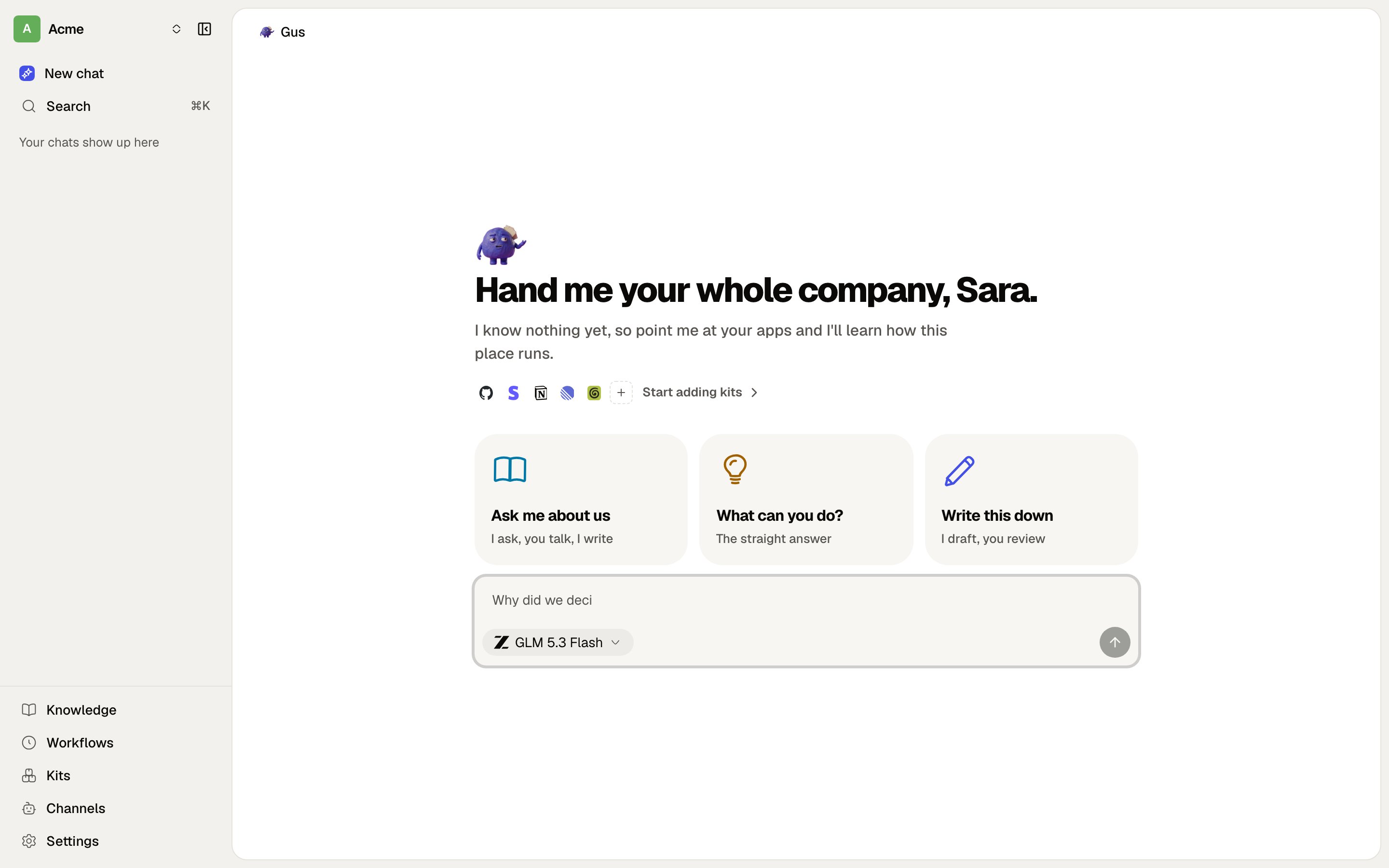
* **Gus.** The built-in assistant. Answers from your context in the app, in Slack, in Discord and on
Telegram, and can go and do the next thing rather than just replying.
* **Connections.** Your team's tools, reached through a gateway that keeps vendor tokens sealed at rest.
* **Brain as Code.** A repository's own `brain/` folder syncs with a space, so context written in a pull
request lands in the wiki, and context written in the wiki lands in the repo.
## What it is not
Meeting notes are not part of a self-hosted install. The notetaker runs on a recording account that cannot
be handed on, so it exists only on the hosted version at craftspace.app.
It is also not offline. Gus needs an OpenRouter key and a Vercel Sandbox, and both are set up after the
install is running. See [what you need](/quickstart#what-you-need).
Docker, a release binary, or from source.
Point Claude Code, Cursor or Codex at your own endpoint.
One Fastify process, an embedded Postgres, a sealed connection gateway.
The house rules, and what to expect from us.
## What is in it
* **Pages and playbooks.** Plain markdown, arranged as a wiki. Spaces are the permission boundary: one
shared space per project, plus a personal space per member.
* **An MCP endpoint per organisation.** Any agent that speaks MCP can list, search, read and write your
pages, with OAuth and per-agent scoping.
* **Gus.** The built-in assistant. Answers from your context in the app, in Slack, in Discord and on
Telegram, and can go and do the next thing rather than just replying.
* **Connections.** Your team's tools, reached through a gateway that keeps vendor tokens sealed at rest.
* **Brain as Code.** A repository's own `brain/` folder syncs with a space, so context written in a pull
request lands in the wiki, and context written in the wiki lands in the repo.
## What it is not
Meeting notes are not part of a self-hosted install. The notetaker runs on a recording account that cannot
be handed on, so it exists only on the hosted version at craftspace.app.
It is also not offline. Gus needs an OpenRouter key and a Vercel Sandbox, and both are set up after the
install is running. See [what you need](/quickstart#what-you-need).